

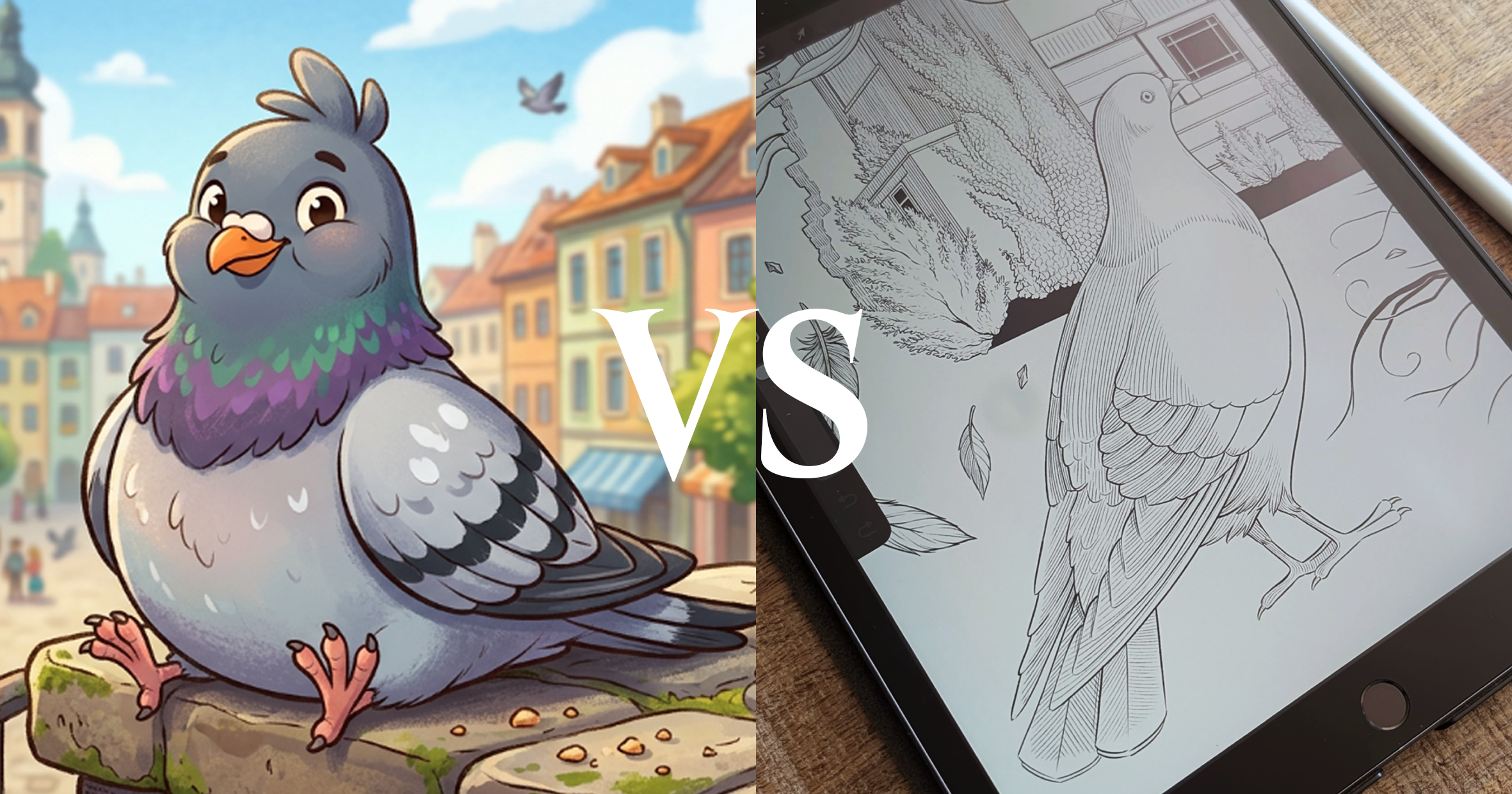
There’s a conversation happening in a lot of marketing meetings right now that goes something like this: why are we paying for illustration when we could just generate something?
It’s a fair question to ask. The tools are cheap, the turnaround is fast, and the output looks pretty convincing at first glance. But ‘pretty convincing at first glance’ is not the same as good design, and for brands that care about how they come across, that difference is crucial.
AI-generated design is often just bad design
Not just ethically questionable, not just philosophically complicated, but also bad in the practical sense that design professionals use the word.
AI image generation is trained to produce what’s statistically popular, which means it tends toward visual overload: too many focal points, inconsistent styling within a single image, and details that don’t quite add up when you look closely. You wouldn’t publish a piece of copy with a typo in it just because most people could still get the gist. The same logic applies to a design where the proportions are slightly off, the style shifts between elements, or something in the background doesn’t make visual sense. People notice, even when they can’t articulate why.
More fundamentally, AI has no brief. It has a prompt - and a prompt is not the same thing as a brief.
What a brief actually does
When a brand commissions an illustrator, they’re not just buying an image, they’re buying the thinking behind it.
When I start a new project, I’m not just thinking about what to draw. I’m thinking about the person who’s going to see it: what they care about, what they trust, what makes them likely to stop and look and what makes people switch off. I’m looking at the brand’s existing visual world and working out how this piece fits into it. The decisions about colour, composition, and detail all come from that context. They’re not arbitrary and they’re not statistical. They’re specific.
A prompt only produces an image that fits the words you typed, regardless of its wider context.
The trust problem
There’s something else worth considering, which is growing more relevant by the day.
Public trust in AI-generated content is falling. People are increasingly sceptical of what they see online, and many are actively looking for signs of authenticity, and evidence that what they’re looking at was made by a real person with a real point of view. When a brand’s visual content can be traced back to an actual illustrator, with a name, a body of work, and a presence in the world, that’s a trust signal. It tells people that someone cared enough to make something properly.
When it can’t be traced back to anyone, the opposite applies. More and more, audiences are making that association: AI content signals that a brand cut corners. For some businesses that’s a manageable risk, however, for brands built on quality, craft, authenticity, or community, it can be a dangerous gamble.
The practical reality
None of this means illustration is right for every budget or every brief. But it does mean that the comparison between commissioned illustration and AI generation isn’t as simple as cheap versus expensive.
The real question is what do you want your brand’s visual identity to do? If the answer involves standing out, building trust, communicating something specific to a specific audience, or producing work that holds up over time, then illustration is doing a job that generation simply can’t replicate.
I’m Clare, the human behind Falco Creative, and I make hand-drawn illustrations for brands, publishers, and heritage organisations who want their work to feel considered and human. If you’re working on a project and want to talk through whether illustration is the right fit, I’d love to hear about it.
